
How to Choose a Web Design Agency
in Sydney
WHAT YOU’LL LEARN
Portfolio and Proof
Check that their work is relevant and real.
Questions to Ask
Get clear answers on scope, SEO and support.
Quote Comparison
Compare like for like, not just the price.
Red Flags
Spot vague promises before you sign.
Shortlist Scorecard
Score every agency the same way.
01 What a Good Agency Actually Does
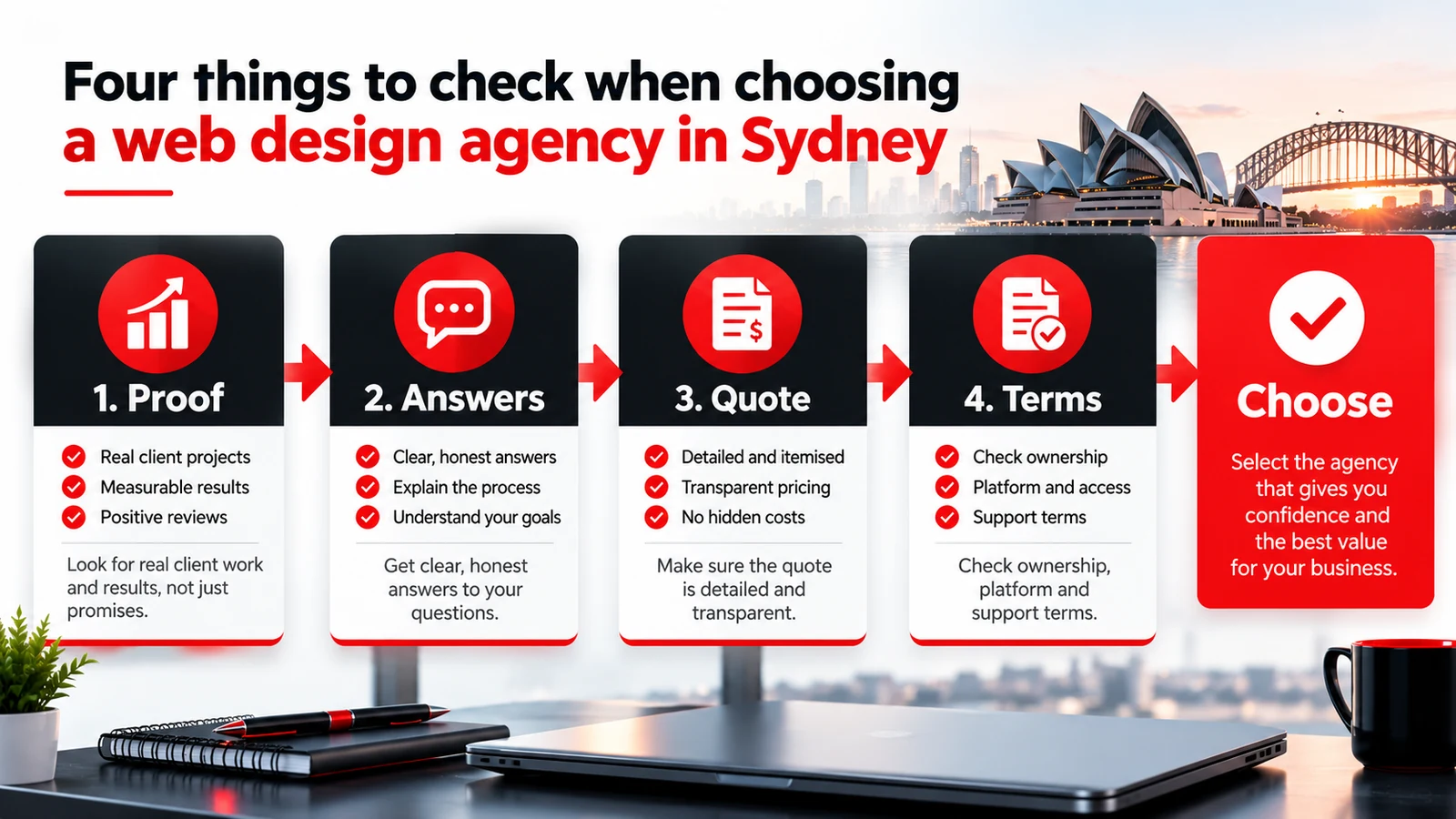
Quick answer: choose an agency by checking four things: relevant proof of past work, clear answers to your questions, a quote that spells out exactly what you get, and straightforward terms about who owns the website and who supports it after launch. The cheapest quote and the flashiest portfolio are the two easiest things to compare, and the two least reliable.
For a small business, a good agency should cover design, development, content structure, SEO foundations, mobile performance and a launch plan. If any of those are “extras” or missing from the quote, you want to know before you sign.
This guide gives you a checklist you can use on any agency, including us. If you’re still working out budget, start with our website cost guide. If you’re planning a new site, our SEO for a new website guide covers what to sort out before launch.
02 Decide What You Need Before You Compare
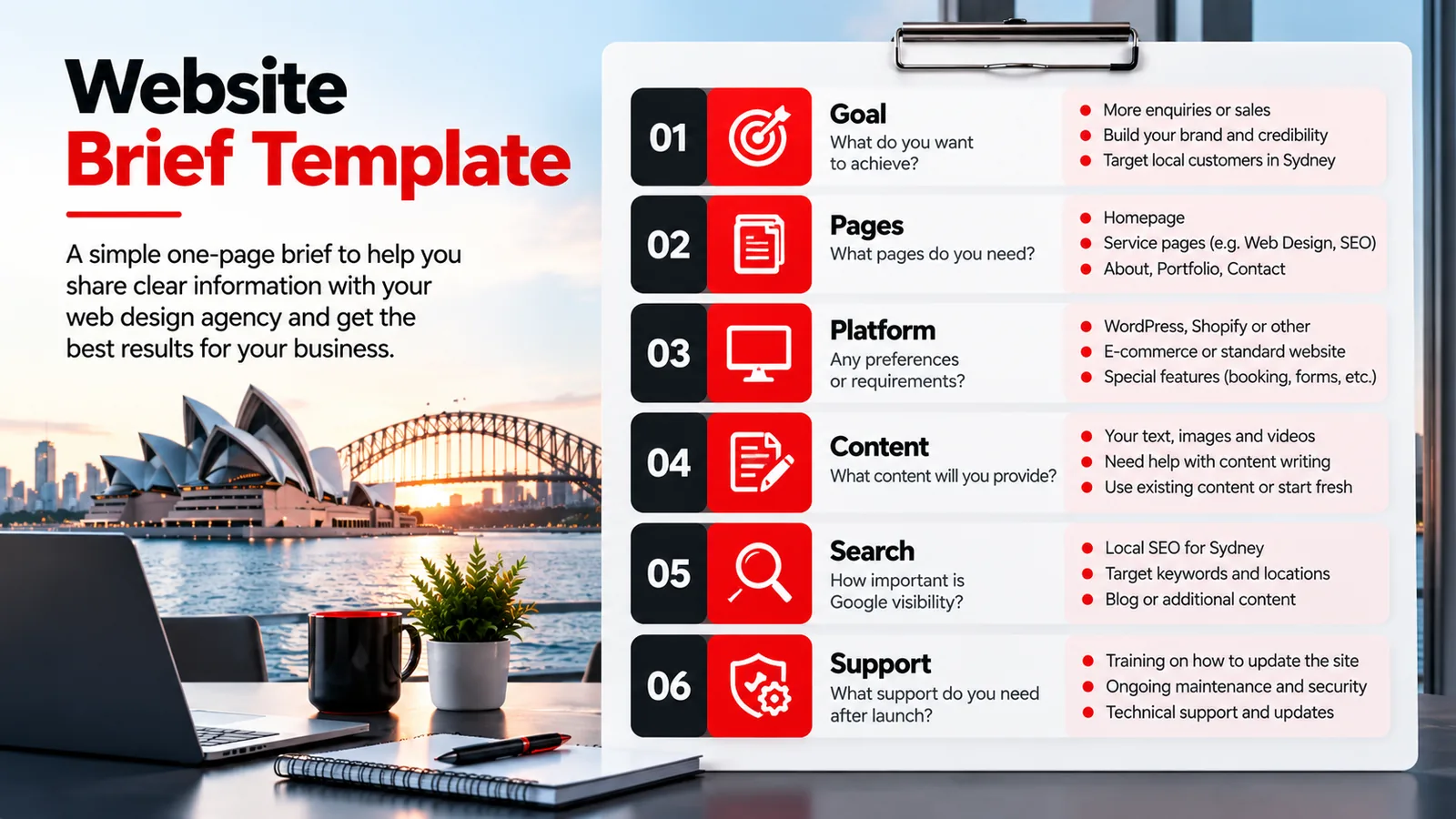
- Goal: more enquiries, online sales, bookings or credibility?
- Pages: how many, and which ones matter most?
- Platform: WordPress, Shopify, WooCommerce or something else?
- Content: who writes the words and sources the photos?
- Search: do you need to be found on Google from day one?
- Support: who updates, secures and backs up the site after launch?
Even a half-page brief changes the quality of the quotes you get. Agencies that receive the same brief give you answers you can compare. Agencies that hear “I need a website” give you guesses.
If you’re not sure about some of the answers, say so and ask each agency how they would decide. Their reply tells you a lot about how they work.
A small business site usually needs a clear structure, fast mobile pages, an easy way to contact you and the basics of SEO. Anything beyond that, such as bookings, several languages or an online store, should be named in the brief.
03 Check the Portfolio and Proof
Look past the screenshots. Open the live sites, test them on your phone and see how fast they load. Then look for a case study that explains the problem, the work and the result.
What to look for. A strong portfolio and case study usually shows:
- Live websites you can open and use, not just mockups.
- Work for businesses similar to yours in size, industry or goal.
- Clear descriptions of what the agency did, such as design, SEO or booking features.
- Results with dates and a named source, such as Search Console, instead of vague claims.
- Honest limits, like which results came from several kinds of work together.
- Client reviews you can check on Google.
Ask for a reference or a short call with a past client if the project is large. A good agency won’t mind. Remember a portfolio only shows the wins, so ask what a project looked like when it got difficult.
The table below shows what each type of proof tells you, and what it can’t.
| Type of proof | What it tells you | What it doesn’t tell you |
|---|---|---|
| Live website | How it looks, loads and works on your phone | Whether it brings in enquiries |
| Case study with data | The problem, the work and a measured result | Which part of the work caused the result, unless they explain |
| Google reviews | How clients felt about communication and delivery | How well the site was built |
| Screenshots or mockups | The design style | Whether the site is live, fast or looked after |
| Awards and badges | Some level of recognition or approval | Whether the agency suits your project |
| Reference call | What it was like to work with them day to day | Anything the client was asked not to share |
Keep a simple record. For each agency, note the sites you opened, what you liked, what loaded slowly and whether the case studies showed real results. You’ll need it when you compare them later.
04 Questions to Ask Every Agency
- Ask each agency the same questions, in writing, so you can compare the answers.
- Listen for specifics. A good answer names the process, the people and the trade-offs.
- Ask what’s included, what costs extra and who does each task.
- Ask how they handle SEO, speed and mobile before launch.
- Ask what happens if you want to leave or change agencies later.
- Notice how quickly and clearly they reply. That’s how support will feel too.
You don’t need technical knowledge to judge the answers. Vague replies, buzzwords and promises of guaranteed rankings are the warning signs. Clear, plain answers that explain the reasoning are a good sign.
The table below lists the key questions, what a good answer sounds like and what should worry you.
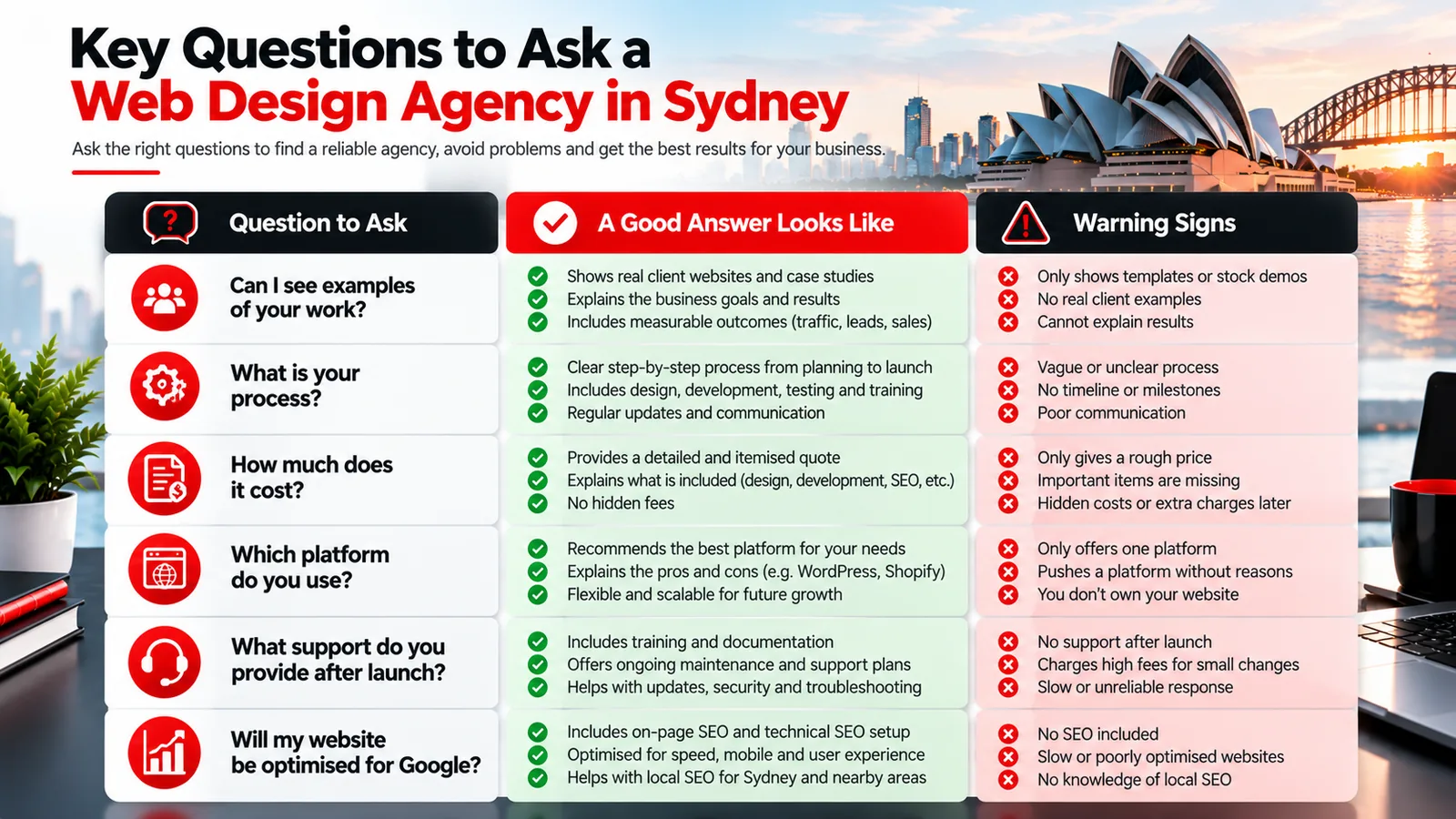
| Question | A good answer sounds like | A warning sign |
|---|---|---|
| What exactly is included in the quote? | A list of pages, features, revisions, content help, SEO setup and launch tasks | “Everything you need” with no list |
| Who will work on my website? | Names the roles and who you’ll deal with day to day | Can’t say who does the work or who you’ll talk to |
| How do you handle SEO? | Explains site structure, page speed, page titles, redirects and tracking | Promises “page one” or guaranteed rankings |
| Who owns the website, domain and content? | You do, in writing, with logins handed over | Hosting and code are tied to the agency with no exit terms |
| What happens after launch? | Explains support, updates, backups and how to request changes | Support isn’t mentioned or has no stated cost |
| How long will it take, and what do you need from me? | A realistic timeline with milestones and what you need to supply | A short timeline with no mention of your content or feedback |
| Can I see similar work? | Relevant live sites and case studies | Only generic or unrelated examples |
05 Compare Quotes Like for Like
Put the quotes side by side and tick what’s included. A lower price often means something is missing, not that the agency is better value. For typical price ranges, see our website cost guide.
| Item | What to check | Common gap |
|---|---|---|
| Design and pages | Number of pages, layouts and rounds of changes | “Custom design” with no page count |
| Build and platform | Which platform, which plugins and who pays the licences | Paid plugins or themes not mentioned |
| Content | Who writes the copy, sources images and how much is included | Content assumed to be “supplied by you” with no guidance |
| SEO foundations | Page titles, structure, speed, redirects and tracking | SEO listed only as an expensive extra |
| Mobile and speed | Mobile layouts and how speed is tested | “Responsive” with no detail |
| Launch and handover | Testing, go-live checks and a handover session | No handover or logins |
| Ongoing costs | Hosting, domain, maintenance and support | Costs after launch not stated |
Ask each agency to explain any line you don’t understand in plain English. If they can’t, that’s useful information. If you want ongoing care after launch, see what’s covered in our website management guide.
06 Red Flags to Watch For
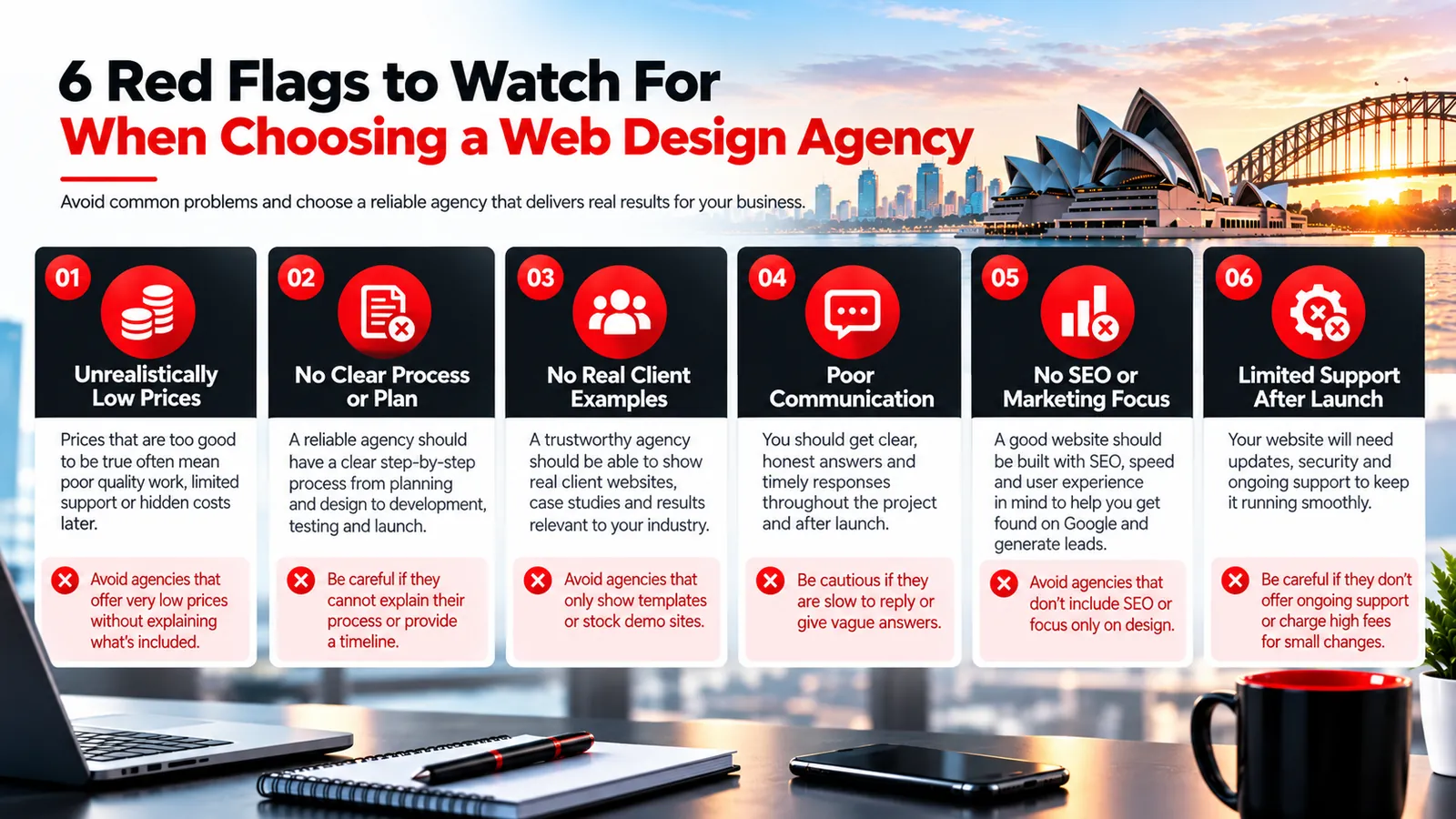
- Guaranteed rankings or “number one on Google” promises.
- A quote with no breakdown, or one that changes after the first call.
- Pressure to sign quickly because of a limited-time discount.
- No live examples, or portfolio sites that are broken or very slow.
- Hosting, domain or login details held by the agency with no handover.
- No clear answer on who supports the site after launch.
One red flag doesn’t mean you should walk away. Ask about it and see how they respond. A good agency explains calmly. A weak one gets defensive or changes the subject.
Also check that the agency’s own website practises what it sells. Is it fast, clear and easy to use on a phone? Can you find the services, case studies and contact details quickly?
| Red flag | Why it matters | What to ask instead |
|---|---|---|
| Guaranteed rankings | No agency controls Google, so the promise can’t be kept | “What SEO work is included, and how will you report progress?” |
| Vague quote | You can’t compare it or hold anyone to it | “Can you break this down by pages, features and tasks?” |
| Locked-in hosting or code | You may struggle to move or update the site later | “Who owns the site, and what do I receive at handover?” |
| No post-launch plan | Sites need updates, backups and security checks | “What support is included, and what costs extra?” |
| Only template examples | They may not suit your goals | “Can you show custom work for a similar business?” |
Keep your questions calm and specific. You’re not trying to catch the agency out. You want to know what working with them will actually be like.
07 Copy-and-Paste Questions for Your Shortlist
- “What’s included in your quote, and what would cost extra?”
- “Which pages, features and revisions are covered, and how many rounds of changes can I have?”
- “Who will I deal with day to day, and who does the design, build and SEO setup?”
- “Can you show two live websites for businesses similar to mine, with results you can explain?”
- “Who owns the domain, website files and content, and what do I receive at handover?”
- “What happens after launch? What support, updates and backups are included?”
- “How do you set up SEO for a new site, including redirects, speed and tracking?”
- “What do you need from me, and what’s a realistic timeline from start to launch?”
One tip: send these by email so you have the answers in writing. Don’t rely on a phone call you’ll half remember a week later. Compare the replies on clarity and speed as well as content.
If you’re planning a new site, our SEO for a new website guide explains the SEO points to raise with any agency.
08 Ownership, Platform and Support
Ownership. You should own your domain name and your content, and you should receive the logins at handover. Ask for this in writing. If an agency holds the domain or hosting in its own name, make sure the agreement says how you can move it.
Platform. Most small business sites run on WordPress, Shopify or WooCommerce. Ask why they recommend one over another for your goals. A widely used platform means more people can support it if you change agencies. A custom or locked system can be harder to move away from.
Support. Sites need updates, security checks and backups, and someone to make changes. Ask what’s included after launch, who responds and how quickly.
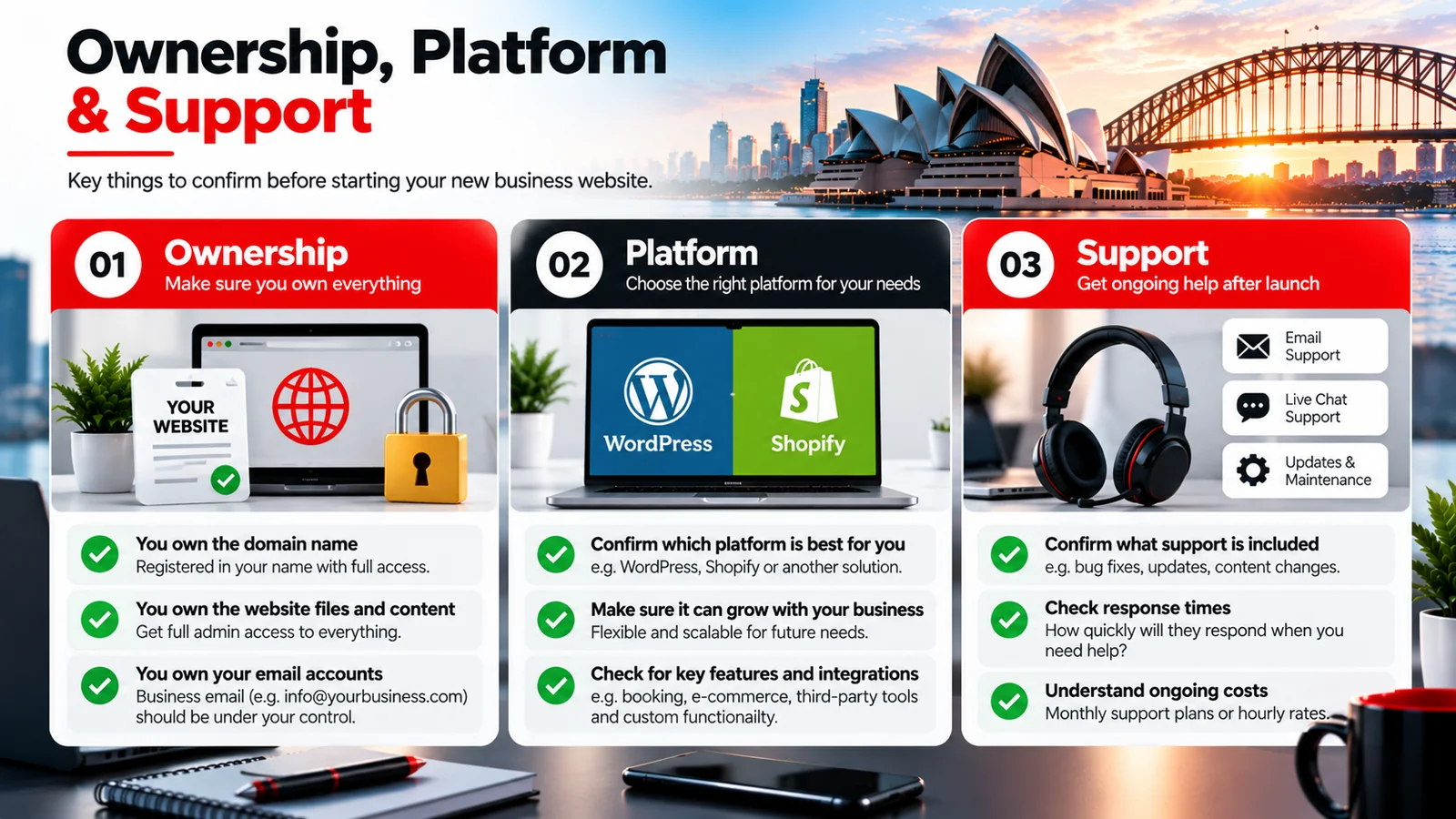
| Area | What to confirm | Why it matters |
|---|---|---|
| Domain name | It’s registered in your name or can be transferred to you | You keep control of your online address |
| Website files and content | You receive your content and a copy of the site at handover | You can move or rebuild later |
| Logins | You have admin access to the site, hosting and analytics | You aren’t dependent on the agency for basic changes |
| Platform and plugins | Which platform, which paid plugins and who pays renewals | Avoids surprise annual costs |
| Hosting and backups | Where it’s hosted and how often it’s backed up | Protects you if something breaks |
| Support | Who to contact, response times and what costs extra | Sets expectations before there’s a problem |
| Platform | Often suits | Watch out for |
|---|---|---|
| WordPress | Content-led business sites that need flexibility and SEO control | Plugins and updates need regular care |
| WooCommerce | Online stores that want to stay inside WordPress | More setup and ongoing care than a hosted store |
| Shopify | Stores that want a hosted, simpler setup | Monthly fees and app costs can add up |
| Custom or locked platform | Very specific needs | Harder to move away from, so check the exit terms |
You don’t need to be technical. You need to hear clear answers and see them in the agreement. If a point isn’t in writing, ask for it to be added.
09 Score Your Shortlist with a Simple Scorecard
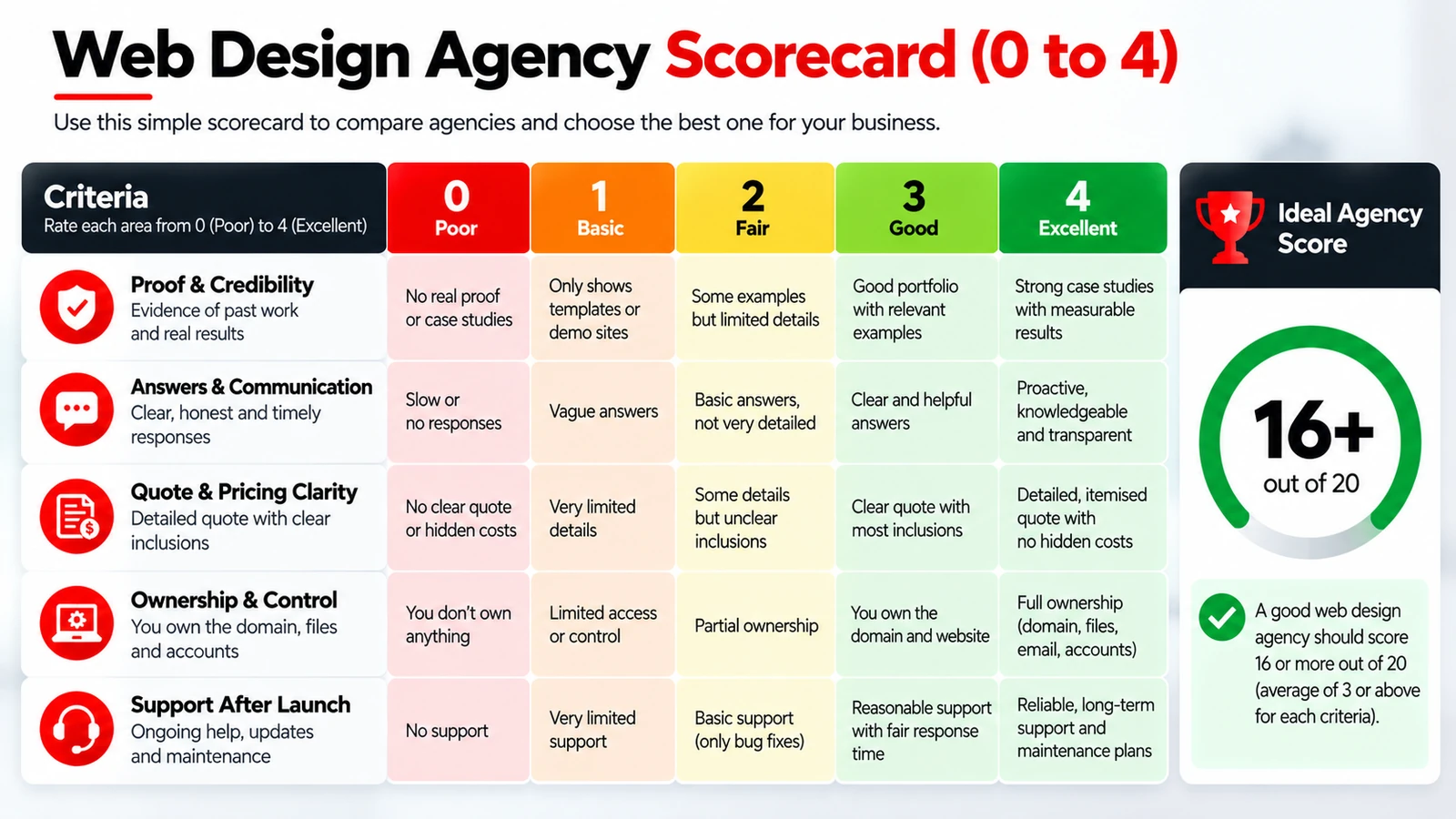
- 0: No evidence or no answer.
- 1: Vague or generic answer.
- 2: Reasonable answer, but little proof.
- 3: Clear answer backed by relevant proof.
- 4: Clear answer, proof and written terms you’re happy with.
- Anything that fails a must-have, such as site ownership, is a no, whatever the score.
Score each agency from 0 to 4 on five things: relevant proof, quality of answers, clarity of the quote, ownership and platform terms, and support after launch. Add them up, then ask yourself whether the highest score also feels like the right team to work with.
The score is a tool for you, not an industry standard. If two agencies finish close, let communication and trust decide.
A quick example. Say Agency A has a polished portfolio but couldn’t explain what’s in the quote, while Agency B has fewer flashy examples but gave clear written answers on ownership and support. Agency B could score higher overall, even though Agency A looked better in the pitch. That’s the point of scoring: it keeps the decision tied to evidence.
10 Worked Example: What Real Projects Show
- Kalimat Translation Services: a multilingual site for NAATI-certified translation in more than 80 languages, with clear service navigation and mobile usability.
- So Fresh Bathroom Renovations: a Sydney bathroom renovation website built to showcase services and strengthen local search visibility.
- Sydney Wide Shuttles: a transport website designed around a fast, mobile-friendly booking journey for airport, cruise, corporate and regional services.
- Relevance: each project suits a different type of business, so you can see which is closest to yours.
- Proof: each case study explains the work done and the Search Console data behind it.
- What to ask any agency: can you show this level of detail for a business like mine?
Kalimat is the clearest example of measured results. Between the first and latest 180 days in Search Console, organic clicks rose from 216 to 377 (+74.5%) and average position improved from 41.08 to 19.16. Read the details in our Kalimat case study.
Our So Fresh case study and Sydney Wide Shuttles case study cover a local service business and a booking-led business.
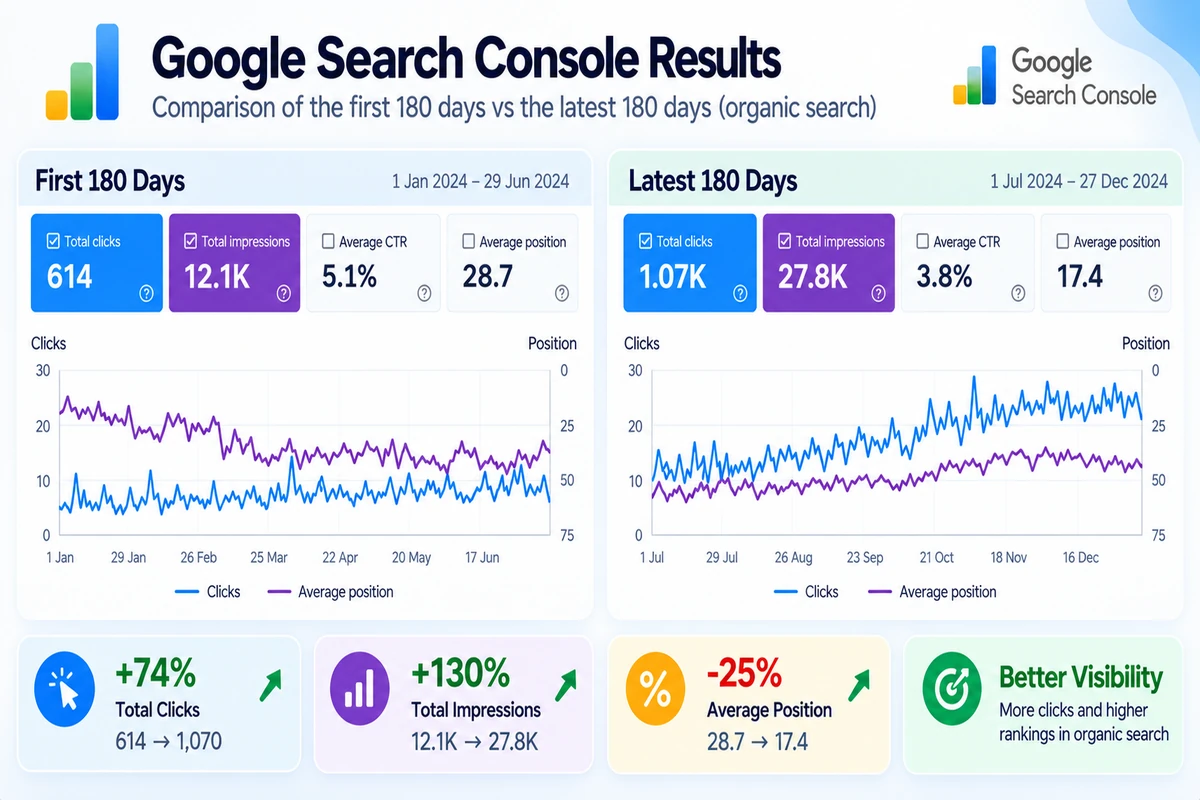
| Measure | First 180 days | Latest 180 days |
|---|---|---|
| Organic clicks | 216 | 377 (+74.5%) |
| Average position | 41.08 | 19.16 |
| Click-through rate | 0.169% | 0.277% |
These are whole-site results from web design, SEO and content work together, so they don’t isolate the effect of any single decision. Treat them as an example of the kind of evidence to ask any agency for, not as a promise of the same result.
11 A Simple Two-Week Process
- Days 1 to 2: Write your brief with goals, pages, platform, content and support needs.
- Days 3 to 4: Build a shortlist of three agencies from referrals, Google and their case studies.
- Days 5 to 7: Send the same questions to each and ask for a written quote.
- Days 8 to 10: Open their live sites, check reviews and, if you can, speak to a past client.
- Days 11 to 12: Score each agency and compare the quotes line by line.
- Days 13 to 14: Check the agreement for ownership, support and exit terms, then decide.
Don’t rush because of a deadline someone else has set. A week’s delay costs far less than a rebuild with the wrong agency. If nobody answers your questions clearly, widen the shortlist and keep going.
12 How Sydney WEB team Answers These Questions
Sydney WEB team is a Sydney-based agency with 20+ years of experience, working with small and growing businesses across Sydney and Western Sydney. We’re Australian-based and listed as an NSW Government Approved Supplier. We build on WordPress and Elementor, and we also work with WooCommerce and Shopify.
Our work covers web design, SEO and Local SEO, digital marketing, e-commerce and AI search, so your website, search visibility and support can be planned together. You can see how it plays out in our Kalimat, So Fresh and Sydney Wide Shuttles case studies, and read our Google reviews on the homepage.
Ask us the same questions in this guide. For next steps, start with web design in Sydney, the website cost guide or our website management guide.
13 Web Design Agency FAQs
How do I choose a web design agency in Sydney?
Start with a short written brief, shortlist three agencies, ask each the same questions, compare the quotes line by line and score them. Check relevant live work, case studies with results and Google reviews.
How much should I expect to pay for a website?
It depends on the number of pages, features, content and ongoing support. Compare what each quote includes instead of just the total. Our website cost guide has typical 2026 ranges for Australian small businesses.
Should I choose a local Sydney agency?
It isn’t a requirement, but a local agency understands your market, can meet in person and works in your time zone. What matters most is relevant proof and clear communication.
Is the cheapest quote usually the best value?
Not always. A low price can mean fewer pages, no SEO setup, no content help or no support. Check what’s included before you compare totals.
Who should own my website and domain?
You should. Ask for domain ownership, admin logins and a copy of your content in writing before the project starts.
Do I need SEO included in my web design?
A new site should have SEO foundations built in: structure, speed, page titles, redirects and tracking. Ongoing SEO is a separate decision. Our SEO for a new website guide explains what to cover before launch.
Which platform is best for a small business website?
It depends on your goals. WordPress suits content-led sites, while WooCommerce and Shopify suit online stores. Ask each agency why they recommend their choice and how easy it would be to move later.
What should happen after my website launches?
Updates, security checks, backups and a way to request changes. Agree who does what, how quickly they respond and what it costs before you sign. Our website management guide explains what to expect.