
SEO RANKING GUIDE SYDNEY
How to Rank Higher on Google in Sydney
Practical SEO Guide
A practical guide for Sydney businesses that want stronger Google visibility. Learn how search intent, service pages, technical SEO, internal linking, local signals, original evidence and website authority work together — and how these elements support a sustainable SEO strategy.
WHAT YOU’LL LEARN
A Smarter Framework for Improving Google Visibility
Search Intent
Match pages to what customers actually want.
Technical SEO
Make priority pages crawlable and understandable.
Topical Authority
Build useful supporting content around core services.
Local Signals
Strengthen Sydney and service-area relevance.
Authority & Evidence
Earn trust with mentions, links and real results.
In This Article
01 What Helps a Sydney Business Rank Higher on Google?
02 Why Is Ranking in Sydney Competitive?
03 How Google Chooses Pages to Show
04 Start With Search Intent, Not Keyword Repetition
05 Build Service Pages Around Commercial Intent
06 Strengthen On-Page SEO and Content Relevance
07 Technical SEO: Crawlable, Indexable and Fast Enough to Use
08 Build Topical Authority Around Core Services
09 Strengthen Local SEO and Sydney Relevance
10 Build Authority With Relevant Links, Mentions and Evidence
11 Use Real Project Evidence Instead of Generic Claims
01What Helps a Sydney Business Rank Higher on Google?
Quick answer: there is no single ranking switch. A Sydney business improves its chances of stronger Google visibility by combining clear service pages, useful original content, sound technical SEO, strong internal linking, local relevance, credible mentions and backlinks, and ongoing measurement.
The most important principle is alignment: the page should answer the searcher’s intent better than competing results and make its purpose clear to both users and search systems. For businesses targeting commercial searches, the main service page should remain the conversion hub while supporting guides answer narrower informational questions.
This guide explains that framework. If you are looking for professional implementation rather than a DIY checklist, see our SEO services in Sydney.

02Why Is Ranking in Sydney Competitive?

Sydney is a large and commercially valuable market, so many high-intent searches attract businesses with established websites, years of content, links, reviews and brand recognition. That means a technically correct page may still sit below stronger competitors.
Competition also changes by query. A suburb-level service search can behave differently from a Sydney-wide commercial term, an informational question or a Google Maps result. A useful strategy therefore separates service intent, location intent and informational intent instead of forcing every keyword onto one page. If you’re targeting a specific suburb, check the areas we serve across Sydney.
Before creating new content, compare what currently ranks: page type, depth, evidence, internal links, local relevance and authority. The goal is not to copy competitors; it is to understand the standard your page must exceed.
03How Google Chooses Pages to Show
- Search intent and topical relevance
- Helpful, original and useful content
- Crawlability and indexability
- Internal linking and site structure
- Website quality and user experience
- Authority, links and brand signals
- Local relevance for Sydney searches
Google does not publish a simple ranking formula. Its public guidance consistently emphasises technically accessible pages and helpful, reliable, people-first content. Structured data can help Google understand page information, but it does not replace useful content or guarantee rankings.
For practical SEO, think in layers: can the page be crawled and indexed; does it match the query; is the content genuinely useful; is the website internally coherent; and are there enough external signals to support trust and prominence?
Google’s guidance for AI features in Search also says the same fundamental SEO best practices remain relevant. See Google’s Search Essentials and AI features guidance, or read our guide to ranking in Google AI Overviews and AI Mode.

04Start With Search Intent, Not Keyword Repetition
Search intent describes what a person is trying to accomplish. A query may be informational, commercial, local or navigational. The strongest site architecture gives each important intent an appropriate destination.
- Commercial service intent: use a focused service page that explains the offer, process, evidence and next step.
- Informational intent: use guides that answer questions in depth and link naturally to the relevant service.
- Local intent: strengthen genuine location relevance, Google Business Profile signals and useful location-specific information.
If you’re looking for practical steps to improve your Google rankings, continue with this guide. When professional implementation is the next step, our Sydney SEO services cover technical SEO, content, local search, authority development and ongoing optimisation.
05Build Service Pages Around Commercial Intent
A homepage rarely needs to rank for every service. When a business offers distinct services, dedicated pages make it easier to explain each offer, target the correct intent and provide relevant proof.
A strong service page should clearly state what is offered, who it is for, where it is available, how the process works, what evidence supports the claims and what action the visitor should take next. Supporting articles can then answer broader questions and link back to that service page when the commercial next step is relevant.
Supporting content works best when it helps readers understand a topic in more detail and provides a clear next step when professional support is needed. The commercial hub should remain the dedicated service page rather than turning every supporting guide into another sales page.

06Strengthen On-Page SEO and Content Relevance

On-page SEO starts with clarity. The title and H1 should describe the page accurately. Headings should organise the topic logically. Copy should answer the questions a prospective customer needs answered rather than padding the page to hit a word count.
Use descriptive internal anchors, useful image alt text, relevant examples and concise definitions where they improve understanding. Avoid forcing the exact same keyword into every heading. Natural language creates room to cover related concepts without making the page read like a search-engine template.
Original experience matters too. Screenshots, project outcomes, before-and-after observations, first-party data and case studies can make a page more useful than generic summaries of information already available elsewhere.
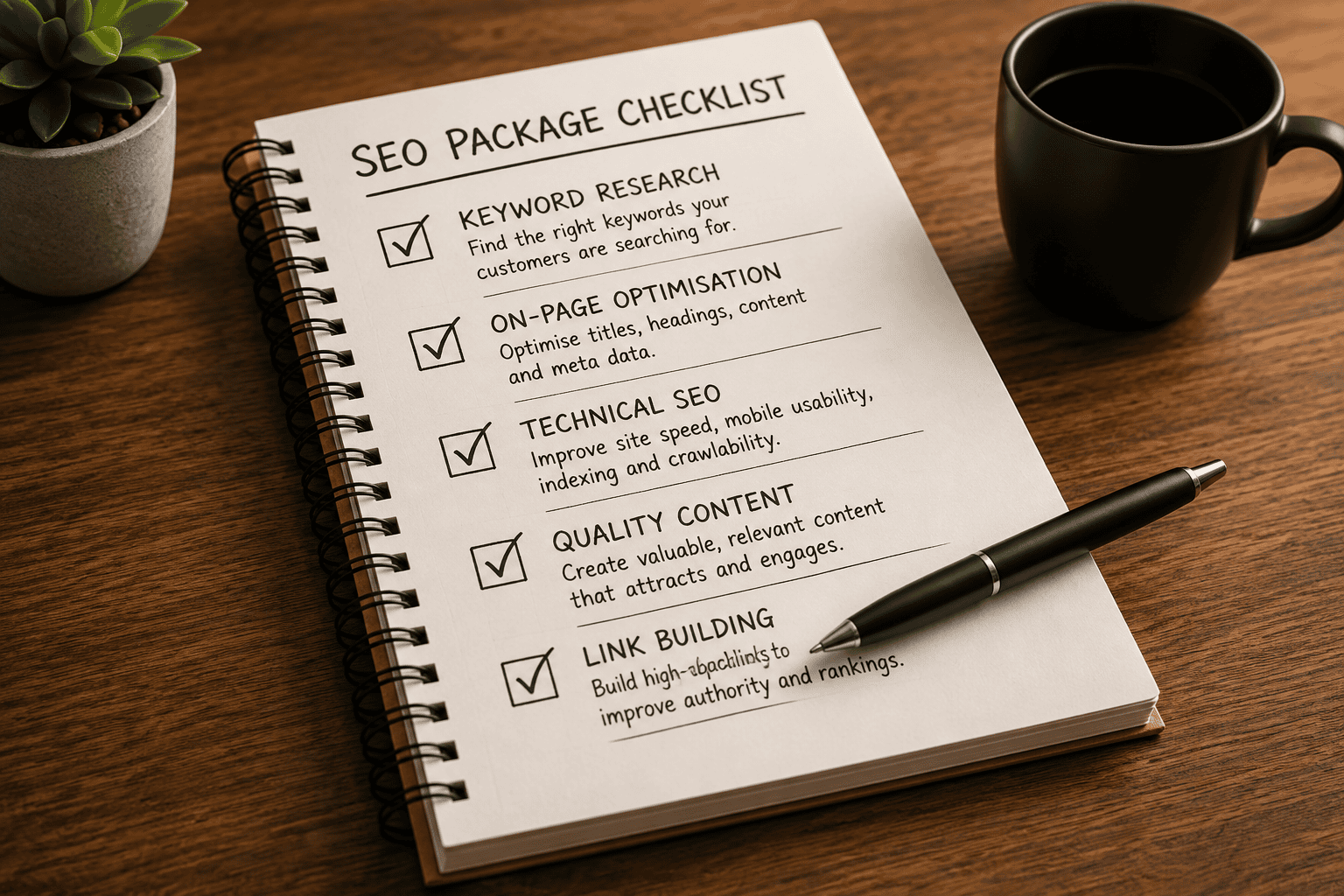
07Technical SEO: Crawlable, Indexable and Fast Enough to Use
- Clear page title and H1
- Logical H2 and H3 structure
- Useful copy that answers the search intent
- Descriptive internal links
- Relevant entities, services and locations
- Helpful image alt text
- Original examples and evidence
- Clear next step for the visitor
Indexing and ranking are different. Indexing means a search engine has discovered and stored a page. Ranking determines where that page appears for a particular query. Being indexed therefore does not mean a page deserves a top-ten position.
Technical SEO should remove barriers: correct status codes, sensible canonicals, crawlable navigation, mobile usability, reasonable performance, clean redirects, accurate sitemaps and structured data that matches visible content. Internal links should make priority pages easy to reach.
After technical foundations are sound, ranking gaps often move to relevance, content quality, authority, intent alignment or competition. You can use our free SEO checker as a first-pass review, then investigate important issues in Search Console.
08Build Topical Authority Around Core Services
Topical authority is not created by publishing dozens of near-duplicate posts. A stronger model is a clear hub with supporting pages that each answer a distinct question.
For an SEO service cluster, useful supporting topics can include cost, local search, technical problems, ranking diagnostics, AI-search visibility and real project evidence. Those pages should link to one another where helpful and point back to the core service when the reader reaches commercial intent.
For example, businesses comparing investment levels can read our SEO cost in Sydney guide, while businesses considering visibility beyond traditional search can use our guide to getting found on ChatGPT and AI search. Together with our local SEO resources and case studies, these pages support the central professional SEO services in Sydney page without duplicating its commercial purpose.
For businesses considering a dedicated GEO strategy, our guide to AI search optimisation costs in Australia explains the factors that influence pricing and what different packages may include.
09Strengthen Local SEO and Sydney Relevance
For businesses serving Sydney locations, local SEO can include Google Business Profile optimisation, consistent business information, reviews, relevant citations, local landing pages, internal links and content that genuinely helps customers in the target area.
Location pages should be useful and distinct. Thin pages that merely swap suburb names add little value. Strong local pages can include service availability, project evidence, area-specific considerations, FAQs, testimonials or examples that are genuinely relevant to that location.
For the detailed local framework, read our Local SEO guide for Sydney small businesses.
We work with businesses across Sydney and surrounding areas. See the full list of Sydney areas we serve.

10Build Authority With Relevant Links, Mentions and Evidence
Competitive search results often contain websites with stronger external authority. Closing that gap can involve genuine editorial mentions, industry citations, partnerships, supplier profiles, professional associations, useful contributed content, digital PR and resources that other sites have a reason to reference.
Quality matters more than raw volume. A relevant mention from a credible Australian business or industry source can be more meaningful than large numbers of unrelated links. Avoid strategies built around automated links, paid link networks or repetitive exact-match anchor text.
Internal authority matters too. Important pages should receive contextual links from relevant guides, service pages and case studies so visitors and crawlers can understand which pages are central to the site.
11Use Real Project Evidence Instead of Generic Claims
Case studies can demonstrate experience that generic advice cannot. Useful evidence may include Search Console trends, landing-page growth, local visibility, technical improvements, conversion changes and the reasoning behind the work.
REAL SEO EXAMPLE
So Fresh Bathroom Renovations
Sydney WEB team’s published project evidence documents SEO work for a Sydney bathroom renovation business, including local landing pages, content, technical improvements and local-search work. Rather than treating a result as a promise for every website, the case study provides the project context behind the strategy and measured outcomes. View the So Fresh SEO case study.
Sydney WEB team also publishes project evidence for Sydney Wide Shuttles and Kalimat Translation Services. Explore the SEO and website case studies for the wider project context. When adding evidence to any article, keep dates, measurement periods and claims accurate so readers can understand exactly what the numbers represent.
12Measure SEO Progress Beyond One Ranking

- Search impressions and clicks
- Landing-page visibility and query growth
- Average position as a diagnostic signal
- Qualified enquiries and conversions
Track performance at several levels: impressions show search visibility; clicks show traffic earned; average position can reveal movement; landing-page data shows which pages are gaining; and conversions show whether visibility is producing useful actions.
For local businesses, also monitor Google Business Profile interactions and local visibility. Compare periods carefully and annotate major website changes so improvements or declines have context.
SEO should be reviewed as a system. A page can gain impressions before clicks, clicks before leads, or rankings for secondary queries before the main commercial term moves. Use those signals to decide what to improve next rather than reacting to a single daily position.
13SEO Ranking FAQs and the Next Step
Why is my website indexed but not ranking?
Indexing only means the page is eligible to appear. Weak intent alignment, stronger competitors, limited authority, thin content or poor internal support can still hold rankings back.
Do backlinks still matter?
Relevant, legitimate links and mentions can contribute to website authority and discovery, but quality, context and natural acquisition matter more than raw counts.
Does publishing more articles automatically improve rankings?
No. Supporting content is most useful when it fills a real information gap, demonstrates expertise and connects logically to important service pages.
Can AI-ready content help traditional SEO?
Clear, well-structured, original content can serve both users and AI-assisted search experiences. For dedicated frameworks, see our ChatGPT and AI search visibility guide and our Google AI Overviews and AI Mode guide.
How much does SEO cost in Sydney?
Pricing varies with competition, website condition, scope and the amount of technical, content, local and authority work required. See our Sydney SEO cost guide for a detailed explanation of the factors that influence investment.
Want a Smarter SEO Strategy for Your Website?
This guide explains the factors that can help a Sydney business improve its organic visibility. Our SEO Sydney service focuses on implementing those improvements through technical SEO, content strategy, local SEO, authority development, measurement and ongoing optimisation. Use this guide to understand the ranking framework, then review the service page when you want those priorities planned around your website, market and competition.
SEO RANKING GUIDE SYDNEY