
GOOGLE AI SEARCH GUIDE 2026
How to Rank in Google AI Overviews & AI Mode
A Guide for Australian Businesses
Google AI Overviews and AI Mode are changing how people discover information in Search, but the foundations of visibility remain familiar. Pages need to be accessible to Google, genuinely useful to people, clear about who the business is, what it offers and where it operates, and supported by credible evidence. This guide explains how Australian businesses can apply those principles to improve their visibility across Google’s AI-powered search experiences.
WHAT YOU’LL LEARN
How AI Search Works
What AI Overviews and AI Mode actually do.
What Helps Visibility
The SEO basics, clear answers and proof that count.
GEO & AEO
What’s useful and what’s mostly hype.
AI Prompt Coverage
The questions your customers ask AI.
Measurement
How to see your AI visibility in Search Console.
In This Article
01 What Are Google AI Overviews and AI Mode?
02 Does Traditional SEO Still Matter for Google AI Search?
03 How Google AI Finds and Selects Supporting Information
04 8 Ways to Improve Visibility in Google AI Search
05 Do You Need GEO, AEO or Special AI SEO?
06 What Does Not Help You Rank in Google AI Search?
07 How Australian and Sydney Businesses Can Prepare for AI Search
08 How to Measure AI Overviews and AI Mode Visibility
09 Google AI Search Readiness Checklist
10 Example: A Real Page From Our Own Site
11 Questions Customers May Ask AI About Your Business
01 What Are Google AI Overviews and AI Mode?
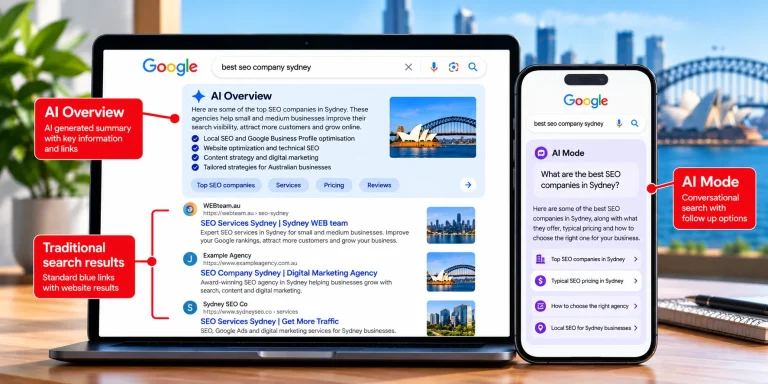
Quick answer: Google AI Overviews and AI Mode are AI-powered features inside Google Search. They pull together information from several sources and link to pages people can open to learn more. You can’t pay for a spot in them or unlock one with special markup. To be considered at all, a page needs to be indexed, readable by Google and genuinely useful.
For Australian businesses, that widens the opportunity. You’re no longer fighting for one blue link on one keyword. A helpful page can show up for questions about what a service involves, how options compare, what it costs and who does it locally, as long as it explains things clearly and backs them up.
Google’s own advice is that normal SEO is still the foundation for these features. You can read it in Google’s official guide to optimising for generative AI features, first published in May 2026 and updated in June.
02 Does Traditional SEO Still Matter for Google AI Search?
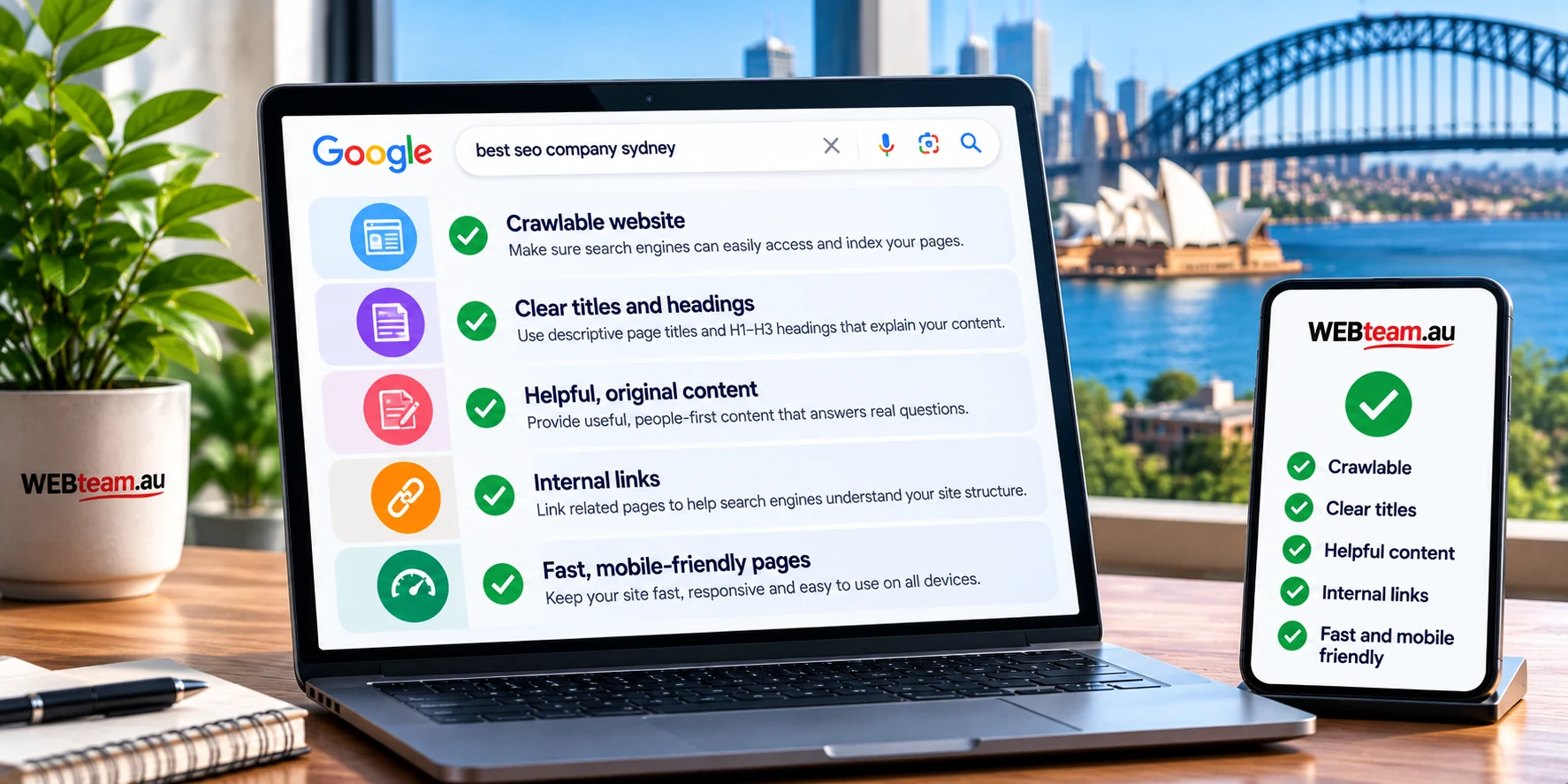
- Keep your important pages crawlable and indexable
- Answer real customer questions clearly, and early on the page
- Share your own examples, results and experience
- Make it obvious who you are, what you do and where you work
- Link related pages together in a way that makes sense
- Use structured data that matches what's actually on the page
- Add useful images and video, with descriptive alt text
- Earn real trust through reviews, mentions and case studies
Start with the basics. Your important pages should be easy for Google to find, crawl and index. Clear titles, descriptive headings, helpful copy, sensible internal links, accessible images and healthy technical performance still do most of the work.
One thing people often forget is that a page also has to be eligible to show a snippet. If Googlebot is blocked, a page carries a noindex or nosnippet tag, or a CDN or security tool is challenging Google’s crawler, nothing else on this list will matter. It’s worth checking before anything else.
And please don’t rewrite a perfectly good service page just to squeeze in “AI SEO” or “GEO”. Improve it because it helps a customer understand the service, compare options and make a decision. For the wider foundations, see our SEO services in Sydney and our guide to ranking higher on Google in Sydney.
03 How Google AI Finds and Selects Supporting Information
Google calls this “query fan-out”. When someone asks a bigger question, its AI may run several related searches at the same time, covering different angles, before it puts an answer together.
That means a page shouldn’t just repeat one keyword. It should cover the parts of the topic a customer actually cares about. Someone choosing an SEO provider in Sydney, for example, probably wants to know what’s included, where you work, how much experience you have, what proof you can show, how pricing works and what other customers think. The table below shows how one question can spread out.
| What the customer asks | Related searches Google may run | What your page should cover |
|---|---|---|
| Which SEO agency in Sydney suits a small business? | SEO services for small business, local experience, reviews and case studies, pricing | Who you help, what you do, proof of results, how pricing works |
| How much does a business website cost in Sydney? | Typical price ranges, what drives cost, ongoing costs, DIY vs agency | Real ranges, the factors behind them, what is included, a clear next step |
| How do I show up in AI search? | How AI Overviews work, whether SEO still matters, how to measure results | A plain answer, supporting evidence and how to track progress |
Important: this doesn’t mean every page has to be huge. Cover what’s needed to answer the question properly, then link to deeper pages for the rest. Google also warns against creating a separate page for every possible variation of a query. Original examples, your own observations, case studies and facts people can check are far more useful than generic text that could sit on a hundred other websites.
04 8 Ways to Improve Visibility in Google AI Search
- SEO foundations: pages that can be crawled and indexed, and are relevant and high quality
- Clear answers: short, direct responses under descriptive headings
- Entity clarity: make it obvious who you are, what you offer and where
- Evidence: case studies, examples, credentials and first-hand experience
- Internal links: connect service pages, guides, tools and case studies
- Structured data: accurate markup that matches what's on the page
- Visual content: useful original images with descriptive alt text
- Technical access and speed: fast, mobile-friendly pages that Google can reach
For Sydney WEB team, that means joining up our service pages, guides, case studies and tools instead of creating one-off “AI SEO” pages. A page should show what we do, where we work, which problems we solve and provide real client results and case studies that support those claims.
Our Free AI Visibility Checker is a handy way to spot gaps on a page. Treat it as a diagnostic, though, not a promise of AI citations or rankings.
05 Do You Need GEO, AEO or Special AI SEO?
You’ll hear a lot of acronyms. In plain English, here’s how they fit together:
| Approach | Main focus | Useful work | What to avoid |
|---|---|---|---|
| SEO | Search visibility | Technical health, content, links, relevance, authority | Keyword stuffing and search-first content |
| AEO | Answer clarity | Direct answers, structured headings, useful FAQs | Artificial Q&A written only for bots |
| GEO | Generative visibility | Entity clarity, evidence, citations, comprehensive topic coverage | Treating GEO as a replacement for SEO |
| AI search optimisation | Overall discoverability | SEO + answerability + entities + evidence + measurement | Secret “AI ranking” tactics |
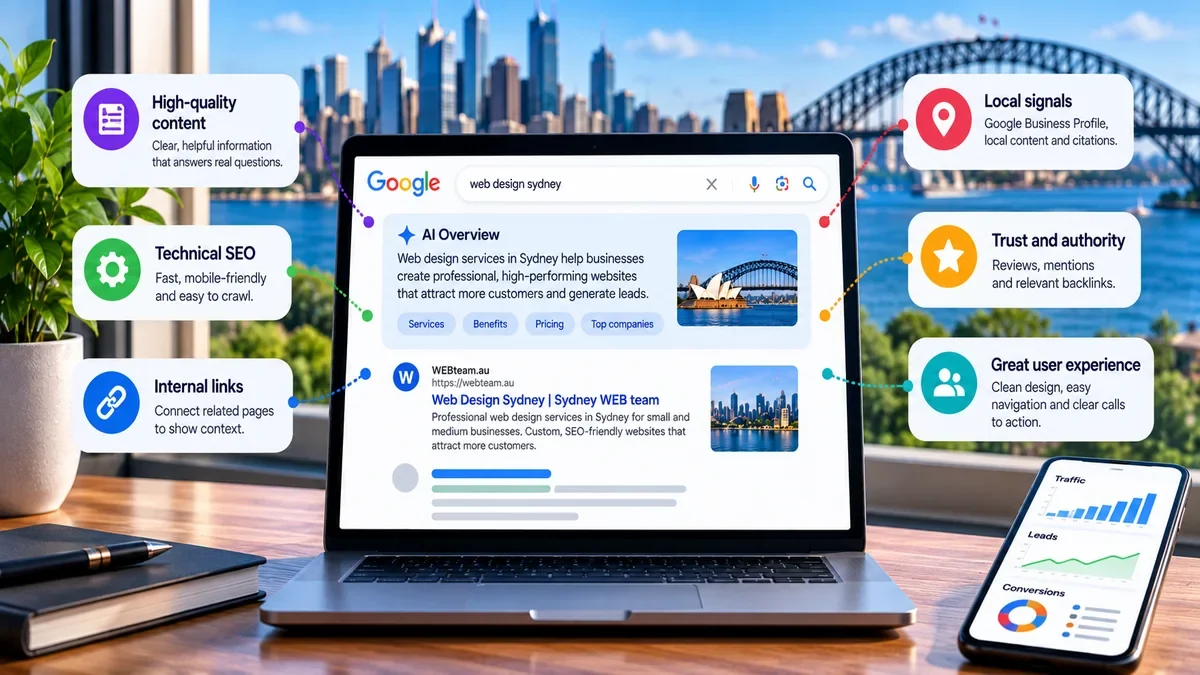
These overlap heavily. You’re not writing for a robot. You’re publishing the clearest, most useful and best-supported answer for the person asking, and making sure search systems can reach and understand the page. If you’d like to see how this applies to AI assistants beyond Google, read our guide to getting found on ChatGPT and AI search.
06 What Does Not Help You Rank in Google AI Search?
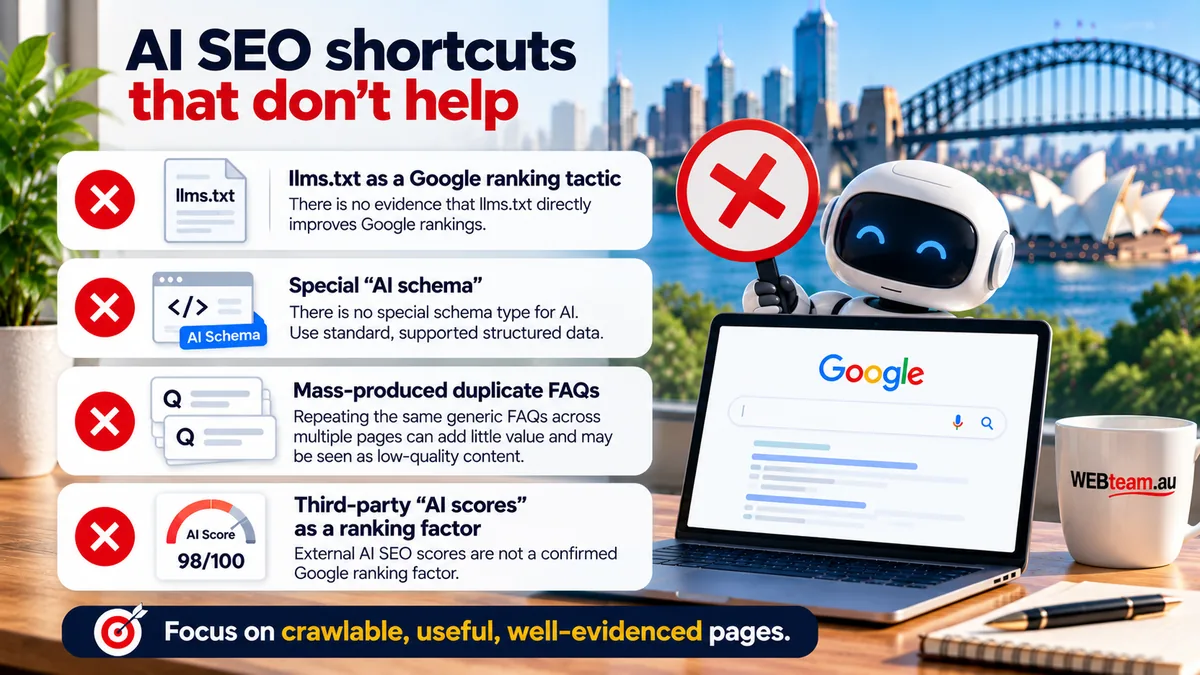
- Making special “AI pages” with thin or copied content
- Stuffing GEO, AEO or “AI SEO” into every heading
- Adding schema that isn't supported by what's visible on the page
- Publishing hundreds of generic, AI-written FAQs
- Using llms.txt as a Google ranking tactic
- Treating a third-party “AI score” as a ranking factor
- Cutting useful detail just to make every answer as short as possible
Google’s 2026 guidance pushes back on several popular myths. You don’t need special AI schema, a separate AI version of your site or an llms.txt file to show up in Google Search. Google says you don’t need to create AI-specific files or markup, and while it may crawl an llms.txt file like any other page, it doesn’t treat it in any special way. (Whether it helps other AI tools is a separate question, and the evidence is still thin.)
Also steer clear of mass-producing near-identical FAQs or chasing a perfect third-party “AI score” as if Google uses it. Readiness tools are good for finding gaps, but real visibility has to be measured in Google Search Console and in your actual search results.
07 How Australian and Sydney Businesses Can Prepare for AI Search
- Say clearly what you do, who it's for and which areas you serve
- Keep your Google Business Profile accurate and up to date
- Make sure your business name, address and phone number match everywhere
- Link service-area pages to the main service pages they relate to
- Show real local examples, projects and case studies
- Collect genuine reviews and reply to them
- Write local pages that add useful detail, not just a swapped suburb name
For a Sydney business, location should add information, not repetition. Explain where you work, what you actually do in those areas and show genuine local examples where you have them. Connect your service-area pages to your main service pages, like our Sydney service areas and the pages for Parramatta, Norwest, Liverpool, Blacktown, Penrith, Canterbury-Bankstown, Fairfield, Camden and the Inner West, so it’s clear how they relate.
The same approach works beyond Sydney. If you serve customers in Melbourne, Brisbane, Perth or regional areas, give each location a page that explains what you actually do there, then link it back to the main service page. Searchers in every state ask the same kinds of questions about cost, suitability and who to trust, so answer them with local detail rather than a copied template.
Reviews, case studies, project evidence and consistent business details all help people and search systems understand who you are. For the local-search groundwork, read our Local SEO guide for Sydney small businesses.
Planning to improve your visibility in Google AI Overviews and AI Mode? Read our guide to AI search optimisation packages and pricing to understand what affects costs and how Australian businesses can plan their AI search strategy.
08 How to Measure AI Overviews and AI Mode Visibility
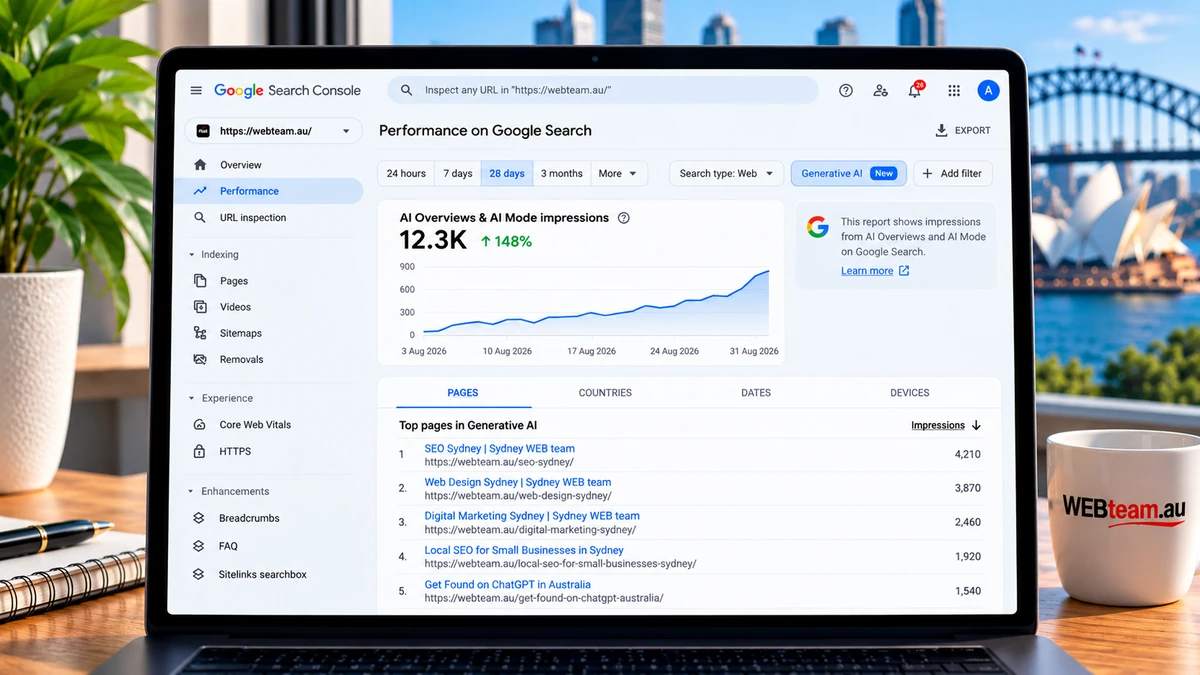
Google announced its Generative AI performance reports in June 2026 and rolled them out to every site worldwide on 31 August 2026. They show impressions from AI Overviews and AI Mode, broken down by page, country and date, and the Search report adds a device breakdown. You’ll find it as a Generative AI tab under Performance.
Know the limits before you read too much into the numbers. The report counts impressions only. It doesn’t show clicks, and clicks from AI features are still counted inside the Web search results in your main Performance report, mixed in with normal results, so don’t add the two together. If your site doesn’t have enough AI impressions yet, you might not see the report at all. Search Console also has a property-level control that lets you opt out of Google’s generative AI features. Most small businesses should leave it switched on, since opting out means no traffic or impressions from them.
Use the report to see which pages already appear in AI features, then compare their structure, coverage and proof with the pages that don’t. Read Google’s announcement of the Generative AI reports, and use our AI Visibility Checker to review on-page readiness.
09 Google AI Search Readiness Checklist
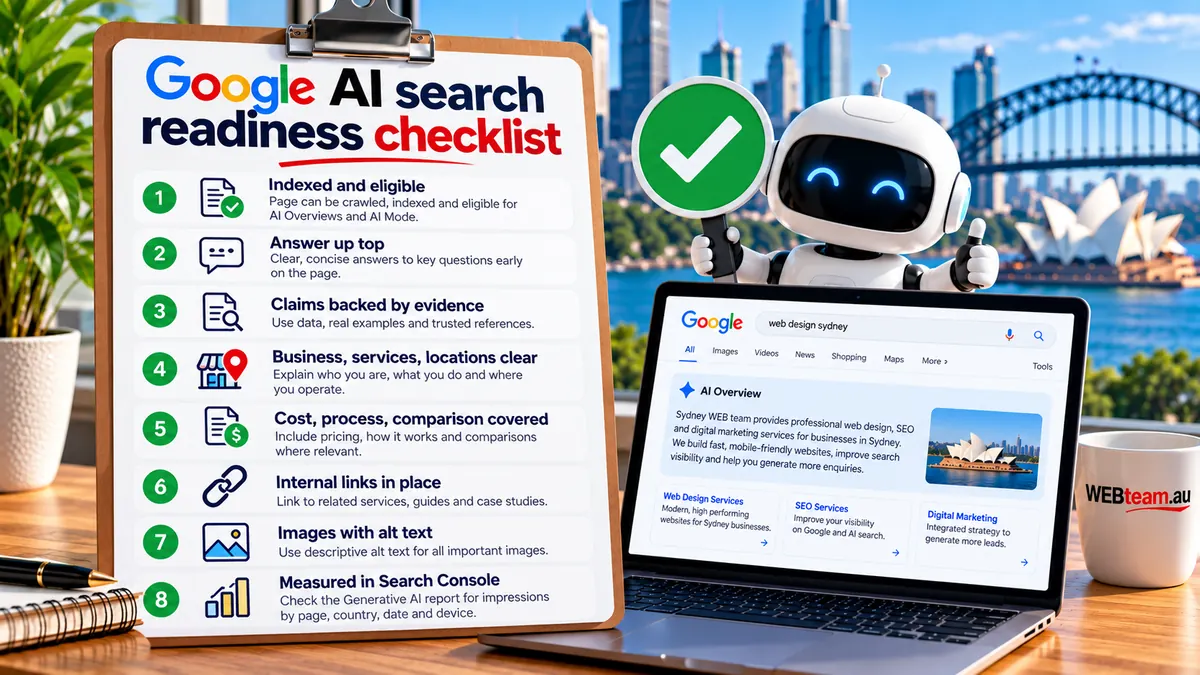
- Is the page indexed and eligible to appear in Google Search?
- Does the opening answer the main question straight away?
- Is every important claim backed by evidence or a trustworthy source?
- Are your business, services and locations clearly stated?
- Does it answer cost, process, suitability and comparison questions?
- Does it link to related service pages, guides and case studies?
- Do the images add information, with descriptive alt text?
- Can you measure how it performs in Search Console?
A strong page has one clear purpose, a descriptive title and H1, short answers near the relevant headings, useful supporting detail, helpful internal links, accurate business information, original evidence where possible, accessible images with good alt text, structured data that matches the visible content and a clear next step.
For AI readiness, also ask whether someone could get answers to comparison, cost, suitability, location, process and “how do I choose?” questions without having to guess. For GEO, make your important claims easy to attribute and check. And for prompt coverage, include the questions real customers ask, in the words they’d actually use.
10 Example: A Real Page From Our Own Site
- Headings written as the questions owners actually ask
- A direct answer near the top of the page
- A plain-English FAQ at the bottom
- Clear Sydney and Australia context
- Links to related services and guides
- Performance tracked in Search Console
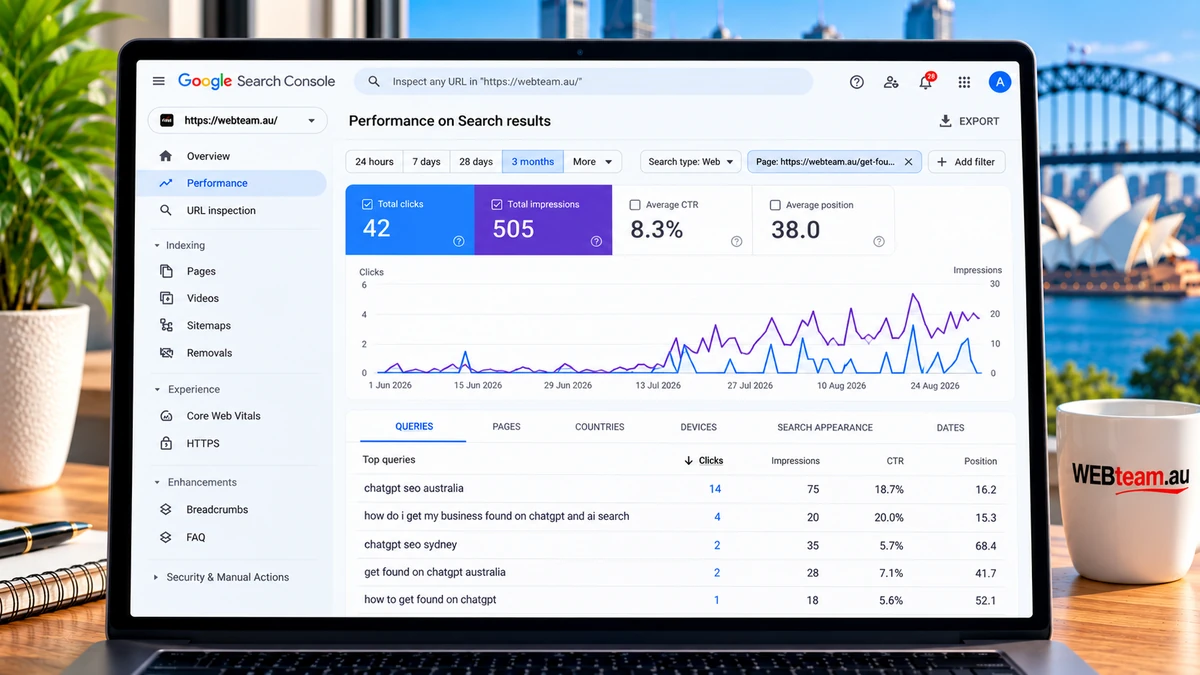
A real example from our own site. Our guide to getting found on ChatGPT in Australia is built the way this article recommends: headings written as the questions business owners ask, a direct answer near the top, a plain-English FAQ and clear Sydney context. Over a three-month period in Google Search Console (Web search), that page earned 42 clicks from 505 impressions, a click-through rate of 8.3% on a young site.
Its best-performing searches were question-shaped. “chatgpt seo australia” brought 14 clicks from 75 impressions at an average position of about 16. “How do I get my business found on ChatGPT and AI search?” brought 4 clicks from 20 impressions, a 20% click-through rate, at an average position of about 15.
What this does and doesn’t show. These are small numbers from a new site, and we can’t prove that any single change caused them. The page’s overall average position is about 38, and location variations such as “chatgpt seo sydney” sit much lower, around position 68, so there’s still work to do. The takeaway is narrower: clear questions, direct answers and focused topic coverage earned clicks before the site had built much authority. These are Google Search Console web results, not a measure of ChatGPT citations or AI Overviews.
The same thinking applies whether you’re an accountant, a builder or a lawyer. Explain who the service is for, what’s included, what affects the price and how it works, then show proof.
11 Questions Customers May Ask AI About Your Business
- “How do I get my business into Google AI Overviews in Australia?”
- “Does SEO still work for Google AI Mode?”
- “What's the difference between SEO, AEO and GEO?”
- “How can a Sydney small business improve its AI search visibility?”
- “Do I need special schema or llms.txt for Google AI?”
- “How do I know if my website appears in AI Overviews?”
- “Which SEO agency in Sydney works with small businesses?”
- “How much does SEO cost in Sydney?”
Please don’t paste dozens of made-up prompts into a page. Use prompt research to find what’s missing from your content instead. If people ask “Which SEO agency in Sydney works with small businesses?”, your site needs to make your audience, location, services and proof obvious. If they ask “How much does SEO cost in Sydney?”, link to a page that answers it directly, like our SEO cost page.
Improve the human page first. AI tools can phrase the same question a hundred ways, so aim for the underlying question and how your business, services and locations connect, not one exact sentence.
To turn customer questions into a practical content plan, read our guide to AI search prompt mapping and GEO strategy. It shows how to build a prompt library, map questions to relevant website pages and identify content gaps across AI search.
12 About Sydney WEB Team and Our AI Search Approach
We try to strengthen the things that make a website useful in both normal and AI-assisted search: easy crawling, clear business details, helpful service information, direct answers, good internal links, structured data where it fits, real evidence from our own work and results we can measure. We don’t treat GEO as a replacement for SEO, and we don’t promise AI citations. Search and AI systems change constantly, so the practical goal stays simple: make every important page easy to find, understand, trust and use.
You can see how we work in our case studies. If you’d like us to look after your site afterwards, read our guide to website management for small businesses.
13 Google AI Search FAQs and Next Steps
Can a business rank in Google AI Overviews?
There’s no separate AI Overview ranking switch. Strong SEO, clear answers, evidence and technically accessible pages improve your chances of being considered.
Does SEO still matter for Google AI Mode?
Yes. Google says SEO best practices remain relevant and foundational for its generative AI features.
What’s the difference between AI Overviews and AI Mode?
AI Overviews put a short AI summary at the top of regular results. AI Mode is a separate, more conversational experience where people can ask follow-up questions and explore a topic in more depth.
Do I need GEO as a separate service?
Not necessarily. GEO can describe useful work aimed at generative visibility, but most of it overlaps with good SEO, clear entities, quality content and authority.
Does llms.txt help Google rankings?
No. Google says you don’t need llms.txt or other AI-specific files to appear in its generative AI search, and it doesn’t treat such a file in any special way.
Do I need special schema for AI Overviews?
No. Google says structured data isn’t required for generative AI search and there’s no special markup to add. It’s still worth using supported structured data that matches what’s visible on the page.
What is query fan-out?
Query fan-out is when Google’s AI runs several related searches at once, covering different angles of a question, before it builds an answer. Pages that cover a topic properly can appear across many of those searches.
How can I measure AI visibility?
Use the Generative AI performance report in Google Search Console. It shows impressions from AI Overviews and AI Mode by page, country, device and date. It doesn’t show clicks, which are still counted in your main Web search report.
Can I opt out of Google’s AI features?
Yes. Search Console has a property-level control for Google’s generative AI features. Opting out means no traffic or impressions from them, so most small businesses are better off leaving it on.
Can a small Sydney business appear in AI search?
Yes. Small businesses can compete by publishing genuinely useful local and service information, keeping their business details accurate and showing real experience and trust.
Sources and further reading: Google’s guide to optimising for generative AI features; Google’s announcement of the Generative AI performance reports; the Search Console help page for the report; and Search Engine Journal on the worldwide rollout.
Want to Improve Your Visibility in Google and AI Search?
Start by checking that your important pages are easy for Google to reach, clearly structured and answering the questions your customers actually ask. Then work on your proof, internal links, business details and measurement instead of chasing shortcuts. Explore our SEO services in Sydney, or run the Free AI Visibility Checker to find where the gaps are.